
Comprehensive Commercial Damage Guide
- Free Claim Review
- 1. Commercial Property Damage Claims: What Business Owners Need to Know
- 2. The Blunt Truth About Commercial Claims (BLUF)
- 3. Why Commercial Claims Are Fundamentally Different
- 4. Types of Commercial Properties We Handle
- 5. Common Insurer Tactics on Commercial Claims
- 6. The Business Interruption Component
- 7. The Empirical Data: Commercial Claim Outcomes
- 8. Immediate Steps After Commercial Property Damage
- 9. Understanding Commercial Policy Fine Print
- 10. The Financial Reality: Fees vs. Value on Large Losses
- 11. Real-World Scenario: The Strip Mall Water Loss
- 12. The Step-by-Step Commercial PA Process
- 13. Frequently Asked Questions About Commercial Claims
- 14. Next Steps: Securing Your Free Commercial Claim Review
1. Commercial Property Damage Claims: What Business Owners Need to Know
When a commercial property suffers damage — whether from fire, hurricane, flooding, or a catastrophic pipe burst — the financial stakes dwarf typical residential claims. A single commercial loss can easily reach six or seven figures, encompassing structural repairs, inventory replacement, equipment damage, and the devastating revenue losses that accumulate while the business cannot operate.
Commercial Damage by the Numbers
Yet despite the magnitude of these claims, most business owners approach them exactly as they would a residential claim — filing the paperwork, waiting for the insurance company's adjuster, and hoping for a fair settlement. This is a strategic error that can cost hundreds of thousands of dollars.
Insurance companies deploy their most experienced adjusters, forensic accountants, and legal teams on commercial claims. The asymmetry of expertise is enormous. Without your own expert, you are negotiating against a team of professionals whose explicit mandate is to minimize the payout.
2. The Blunt Truth About Commercial Claims (BLUF)
Commercial property insurance is a contract between your business and an insurer. When damage occurs, the insurer's fiduciary responsibility is to its shareholders, not your business. Their adjuster's job is to settle your claim as efficiently and inexpensively as possible.
A licensed public adjuster is the only professional legally authorized to represent your financial interests in this negotiation. For commercial claims, they bring in independent structural engineers, forensic accountants to document business interruption losses, equipment appraisers, and contents specialists to ensure every dollar of your loss is captured, documented, and paid.
The data is unambiguous: business owners who hire professional representation recover significantly more than those who negotiate alone — often enough to mean the difference between reopening and permanent closure.
3. Why Commercial Claims Are Fundamentally Different
Commercial claims operate in a different universe than residential ones. Understanding these differences is critical to protecting your business.
Multi-Layer Coverage Residential policies are relatively straightforward. Commercial policies layer multiple coverage types: Building coverage, Business Personal Property (BPP), Business Interruption / Loss of Income, Extra Expense, Ordinance and Law, Equipment Breakdown, Accounts Receivable, Valuable Papers, and more. Each coverage has its own limits, sub-limits, deductibles, and waiting periods. Missing a single coverage line can cost your business tens of thousands of dollars.
Coinsurance Penalties Most commercial policies include a coinsurance clause (typically 80% or 90%). If your building is insured for less than the required percentage of its actual replacement value, the insurer will impose a coinsurance penalty that reduces your payout proportionally. A public adjuster ensures your valuation is properly calculated to avoid this devastating penalty.
The Proof of Loss Deadline Commercial policies typically require a formal, sworn Proof of Loss document within 60-90 days. This is not a simple form; it is a legal document that, once signed, binds you to the stated amount. Submitting an incomplete or undervalued Proof of Loss before understanding the full scope of damage is one of the most expensive mistakes a business owner can make.
Multiple Interested Parties Unlike a residential claim where you are the sole insured, commercial claims often involve landlords, tenants, mortgage holders, equipment lessors, and sometimes multiple insurance carriers. Coordinating the interests of all parties while maximizing your recovery requires experienced commercial claim management.
4. Types of Commercial Properties We Handle
Our network of commercial public adjusters handles the full spectrum of commercial and industrial property claims:
- Office Buildings: Water damage from HVAC failures, fire and electrical damage, wind and hail damage to roofing systems
- Retail Stores & Shopping Centers: Inventory loss, tenant improvement damage, business interruption from forced closures
- Restaurants & Food Service: Kitchen fires, grease fires, refrigeration failures, health department shutdowns
- Warehouses & Distribution Centers: Roof collapses, inventory damage, forklift fires, sprinkler system malfunctions
- Manufacturing Facilities: Equipment breakdown, chemical spills, explosion damage, supply chain interruption
- Hotels & Hospitality: Guest room water damage, hurricane damage, loss of revenue during renovations
- Medical & Dental Offices: Specialized equipment damage, sterilization requirements, patient record replacement
- Multi-Family & Apartment Complexes: Common area damage, individual unit losses, displacement costs for multiple tenants
- Houses of Worship: Historic building restoration, irreplaceable artifact valuation, community gathering space losses
- HOA & Condo Common Areas: Shared infrastructure damage, assessment disputes, reserve fund implications
5. Common Insurer Tactics on Commercial Claims
Insurance companies handle commercial claims differently than residential ones. The stakes are higher, so the tactics are more sophisticated. Understanding what you are up against is the first step to protecting your business.
| Damage Area | Insurer's Approach | PA's Approach |
|---|---|---|
| Building Damage | Repair over replace; ignore code upgrades | Full replacement + Ordinance & Law |
| Business Interruption | Minimize "period of restoration" to weeks | Document full recovery timeline |
| Inventory Loss | Depreciate aggressively; dispute quantities | Forensic inventory + market valuation |
| Equipment | Claim pre-existing wear; partial repairs | Independent appraisal + full replacement |
| Extra Expense | Deny temporary relocation costs as "unnecessary" | Document all mitigation expenses |
The "Quick Settlement" Pressure On commercial claims, insurers know that every day the business is closed, the owner feels increasing financial pressure. They weaponize this urgency by offering a lowball "advance" payment with the implicit understanding that you should accept the initial estimate and move on. A public adjuster neutralizes this pressure by securing interim payments while continuing to negotiate the full value of the claim.
The Forensic Accountant Mismatch For business interruption claims, the insurer will deploy its own forensic accountant to calculate your lost income. This accountant works for the insurance company and has a professional incentive to minimize the documented loss. Without your own forensic accountant, you are accepting the insurer's version of your business's financial reality.
The Scope Limitation Game Commercial buildings are large and complex. An insurer's adjuster may scope damage in the directly affected area while ignoring collateral damage in adjacent tenant spaces, shared mechanical rooms, or common areas. A public adjuster performs a comprehensive, multi-day inspection to capture every affected system.
6. The Business Interruption Component
For most commercial property owners, the Business Interruption (BI) / Loss of Income coverage is where the largest dollar amounts — and the largest disputes — occur. This is the coverage that replaces the revenue your business loses while it cannot operate at full capacity.
The "Period of Restoration" Battle Your BI coverage pays from the date of loss until the property is fully restored to its pre-loss condition. The insurer's goal is to argue the shortest possible restoration period — often claiming your business should be operational in 4-6 weeks when a realistic rebuild takes 6-12 months. A public adjuster documents the actual timeline required for permitting, construction, equipment procurement, and restocking to prove the true period of restoration.
Documenting Lost Revenue You must prove not just that your business was closed, but exactly how much revenue it would have earned during the closure period. This requires detailed financial projections based on historical performance, seasonal trends, growth trajectories, and industry benchmarks. A public adjuster's forensic accountant builds this financial model to maximize your BI recovery.
Extra Expense Coverage If you relocate to a temporary space, rent equipment, or pay employees overtime to maintain operations, these costs are covered under your Extra Expense provision. Many business owners fail to document or claim these expenses, leaving significant money on the table. A public adjuster tracks every qualifying expense in real time.
The 72-Hour Waiting Period Most commercial BI policies include a 72-hour waiting period before coverage begins. However, if the total loss exceeds the waiting period threshold, many policies retroactively cover those first 72 hours. This is a policy nuance that most business owners — and even some insurance adjusters — miss entirely.
7. The Empirical Data: Commercial Claim Outcomes
Commercial insurance claims are asymmetric negotiations. The insurer handles thousands of commercial claims annually; this is likely your first. They deploy teams of adjusters, engineers, and attorneys. Without equivalent representation, you are at a structural disadvantage.
The OPPAGA study (Office of Program Policy Analysis and Government Accountability) found that policyholders with public adjuster representation received settlements 574% higher on non-catastrophic claims and over 747% higher on catastrophic claims. While this study encompassed all claim types, the difference is even more pronounced on complex commercial claims where the scope of damage, policy coverage layers, and business interruption calculations create more opportunities for insurer underpayment.
For a commercial claim valued at $500,000, the difference between an unrepresented settlement and a properly documented, professionally negotiated settlement can easily exceed $300,000 — dwarfing any contingency fee paid to the public adjuster.
8. Immediate Steps After Commercial Property Damage
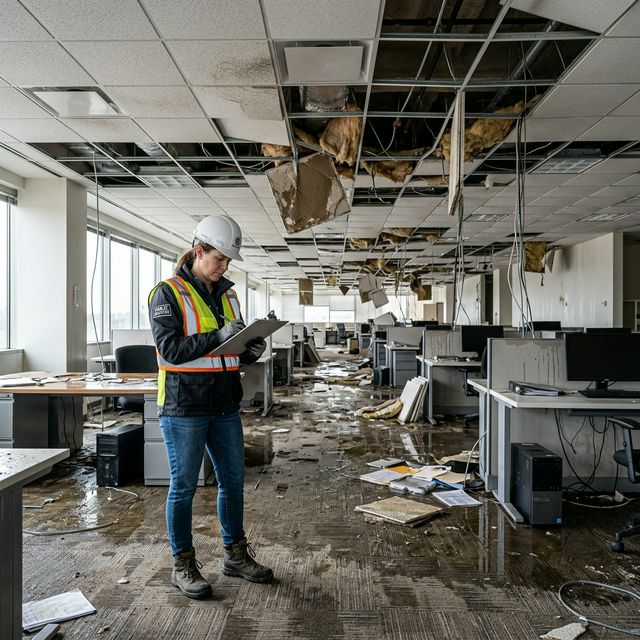
The actions you take in the first 48 hours after a commercial loss set the trajectory for your entire claim. Here is your critical action checklist:
1. Secure the Property and Mitigate Further Damage Your policy requires you to prevent additional damage. Board up openings, tarp compromised roofing, and extract standing water immediately. Document these emergency measures with photos, videos, and receipts — all mitigation costs are reimbursable.
2. Notify Your Insurance Carrier — But Say Nothing Beyond the Facts Report the loss promptly, but limit your statement to the basic facts: date, time, location, and type of damage. Do not speculate on the cause, estimate the value of the loss, or agree to any verbal timelines. Everything you say is recorded and can be used to limit your claim.
3. Do NOT Sign an Assignment of Benefits (AOB) Emergency restoration companies will appear quickly, often offering to "handle everything" with your insurance company. Signing an AOB transfers legal control of your claim to the contractor. Never sign one without independent professional advice.
4. Preserve All Evidence Do not discard damaged inventory, equipment, or building materials until they have been thoroughly documented and inspected. The debris is your evidence. Premature disposal gives the insurer grounds to dispute quantities, conditions, and values.
5. Engage a Commercial Public Adjuster Immediately The earlier a public adjuster is involved, the more control you maintain over the narrative of your claim. They can be present for the insurer's first inspection, coordinate emergency mitigation, and begin building your comprehensive Proof of Loss from day one.
9. Understanding Commercial Policy Fine Print
Commercial insurance policies are dense, highly technical contracts that can run 100+ pages. The difference between a fair settlement and a devastating underpayment often comes down to policy provisions that most business owners have never read.
Coinsurance Clauses If your policy has an 80% coinsurance clause and your building is insured for only 60% of its replacement cost, the insurer will apply a coinsurance penalty that reduces your payout by 25%. On a $400,000 claim, that penalty costs you $100,000. A public adjuster reviews your coverage declarations before filing to ensure proper valuation.
Ordinance and Law Coverage When commercial buildings are damaged, current building codes often require upgrades that exceed the original construction standards. Your standard Building coverage does not pay for code-required upgrades. You must invoke the specific Ordinance and Law endorsement to recover these costs, which can add 20-40% to the total rebuild expense.
Blanket vs. Scheduled Coverage Some commercial policies provide blanket coverage across multiple locations, while others schedule specific limits per building. Understanding which structure applies to your policy determines how limits are applied and can significantly impact your total recovery.
Vacancy Clauses Most commercial policies include a vacancy clause that reduces coverage by 15% or excludes certain perils entirely if the building has been more than 31% vacant for 60+ consecutive days. This is particularly relevant for claims filed on partially leased properties or buildings undergoing renovation.
10. The Financial Reality: Fees vs. Value on Large Losses
The hesitation is understandable: why pay a percentage of your settlement when you can handle the claim yourself? The answer lies in pure mathematics.
The ROI Calculation Consider two scenarios for a major commercial water loss at a retail plaza:
- Scenario A (No Representation): The insurer's adjuster scopes the visible water damage, approves drying and partial drywall replacement, and issues a settlement of $185,000. You accept and spend 8 months trying to complete repairs that ultimately cost $340,000 out of pocket.
- Scenario B (With a Commercial PA): A public adjuster documents hidden moisture behind walls, mold growth in the HVAC plenum, full tenant improvement losses in 3 affected suites, and 5 months of business interruption for displaced tenants. Total settlement: $620,000. After the PA's 8% fee ($49,600), you net $570,400.
The difference is $385,400. The PA fee pays for itself 7x over. This is not hypothetical — it is the mathematical reality of complex commercial claims where hidden damage, business interruption, code upgrades, and tenant losses create layers of coverage that unrepresented business owners routinely miss.
11. Real-World Scenario: The Strip Mall Water Loss
A strip mall owner in South Florida experienced a catastrophic pipe burst in the building's main water supply line overnight. By the time the break was discovered, water had flooded 4 of 6 tenant spaces, destroying flooring, drywall, inventory, and electrical systems.
The Insurer's Assessment: The insurance company's adjuster inspected the property, approved emergency water extraction, and issued an initial estimate of $142,000 covering drywall replacement, flooring, and basic electrical repairs in the directly affected areas.
The Public Adjuster's Investigation: The commercial PA brought in moisture mapping specialists who discovered that water had wicked up inside the walls of all 6 tenant spaces — including the two that appeared dry on the surface. Thermal imaging revealed extensive hidden moisture in the concrete slab, threatening mold growth. The PA's forensic accountant documented 4 months of lost rental income from displaced tenants, plus 2 tenants whose businesses permanently closed, triggering lease break provisions. Additionally, the building's fire suppression system was compromised by the flooding, requiring full replacement to meet current fire code.
The Final Settlement: After rigorous negotiation, the insurer paid $487,000 — more than 3.4x the original offer. The settlement covered full structural remediation, code-required fire suppression upgrades, lost rental income, and tenant improvement allowances.
12. The Step-by-Step Commercial PA Process
Here is exactly what you can expect when you engage a commercial public adjuster through PublicAdjusterSelect:
Step 1: Free Strategy Review Your matched adjuster reviews your commercial policy declarations to understand all coverage types, limits, deductibles, and endorsements. They perform a preliminary damage assessment to determine if professional representation will add value.
Step 2: Emergency Stabilization The PA coordinates emergency mitigation — water extraction, board-up, temporary roofing — and ensures all emergency costs are documented for reimbursement. They secure interim payments for immediate business needs.
Step 3: Comprehensive Multi-Day Inspection Unlike the insurer's 2-hour walkthrough, a commercial PA inspection spans multiple days. They bring in structural engineers, moisture mapping specialists, mechanical engineers for HVAC and electrical systems, and contents specialists for inventory documentation.
Step 4: Business Interruption Documentation A forensic accountant builds a detailed financial model of your business's lost income, using historical tax returns, financial statements, seasonal projections, and industry benchmarks to establish the full revenue impact.
Step 5: Master Proof of Loss Compilation The PA compiles a comprehensive Xactimate estimate and supporting documentation package. For large commercial claims, this can run hundreds of pages and include engineering reports, accountant certifications, and photographic evidence.
Step 6: Direct Negotiation Your adjuster presents the claim to the insurer and manages all negotiations. They debate line items, invoke policy provisions, and leverage appraisal or mediation clauses if the insurer refuses to pay fair value.
Step 7: Settlement and Rebuild Once maximum value is achieved, the PA helps release funds and you retain full control to hire your own contractors for the rebuild.
13. Frequently Asked Questions About Commercial Claims
Can I hire a public adjuster if I've already accepted a partial payment? Yes. Accepting an initial advance or undisputed payment does not waive your right to pursue the full value of your claim. A public adjuster can file supplemental claims to recover the additional amounts your business is owed, provided you did not sign a final release.
Will my commercial insurance premiums increase if I hire a public adjuster? Your premiums are based on claim frequency and severity, not on whether you hire representation. Filing the claim is what triggers potential premium adjustments — hiring a PA to ensure you receive the full settlement you are owed does not independently affect your rates.
How long does a commercial public adjuster take to settle a claim? Complex commercial claims typically take 3-12 months to reach full settlement. The PA's thorough documentation upfront often reduces the overall timeline compared to protracted back-and-forth with an insurer's adjuster. For urgent cases, interim payments are secured within days to keep your business operational.
Do commercial public adjusters handle multi-location losses? Yes. Many commercial PAs specialize in multi-location and portfolio losses, coordinating claims across multiple policies, carriers, and jurisdictions simultaneously. This is particularly common after regional catastrophic events like hurricanes.
What if I have a property manager handling my claim? Property managers are valuable for day-to-day operations, but they are not licensed claim specialists. A public adjuster works alongside your property manager, handling the complex insurance negotiation while your PM manages the physical restoration process.
14. Next Steps: Securing Your Free Commercial Claim Review
Commercial property damage threatens not just a building — it threatens livelihoods, employees, tenants, and the community your business serves. The decisions you make in the days following a loss will determine whether your business recovers fully or suffers a permanent financial setback.
If your commercial property has suffered damage — or if you believe your existing claim has been undervalued, delayed, or improperly denied — you deserve to know the true worth of your loss.
At PublicAdjusterSelect.com, we connect business owners with deeply experienced, fully vetted commercial property public adjusters. The initial review is entirely free, and you pay nothing upfront. Submit your information below, and a dedicated commercial claim specialist will contact you within 24 hours to review your loss and outline your best path to full recovery.