
Comprehensive Restaurant & Retail Damage Guide
- Free Claim Review
- 1. Restaurant & Retail Claims: The Unique Challenges
- 2. The Blunt Truth (BLUF)
- 3. Kitchen Fire Claims: The Most Complex Food Service Loss
- 4. The Commercial Kitchen Equipment Valuation Battle
- 5. Water Damage and Mold in Food Service Environments
- 6. Insurer Tactics Specific to Restaurant Claims
- 7. Health Department Compliance and Recertification
- 8. Perishable Inventory and Food Spoilage Claims
- 9. Retail Store Damage: Inventory, Fixtures, and Tenant Improvements
- 10. Business Interruption for Restaurants and Retail
- 11. Real-World Scenario: The BBQ Restaurant Kitchen Fire
- 12. Frequently Asked Questions
- 13. Next Steps: Your Free Restaurant Claim Review
1. Restaurant & Retail Claims: The Unique Challenges
Restaurants and retail businesses face insurance claim challenges that no other industry encounters. A kitchen fire does not just damage walls — it contaminates ventilation systems with grease-laden smoke, destroys specialized equipment with 16-week replacement lead times, triggers mandatory health department recertification that can add months to your closure, and wipes out thousands of dollars in perishable inventory overnight.
Restaurant & Retail Damage by the Numbers
Retail businesses face their own set of complexities: high-value inventory that fluctuates seasonally, custom tenant improvements (fixtures, signage, display cases), and lease obligations that continue even when the store cannot operate. Both industries suffer disproportionately from extended business interruption because their revenue depends entirely on foot traffic and daily operations.
Standard insurance adjusters — even experienced commercial ones — often lack the specialized knowledge to properly value commercial kitchen equipment, calculate seasonal food service revenue, or navigate health department recertification timelines. You need a public adjuster who has worked food service and retail claims before.
2. The Blunt Truth (BLUF)
Restaurant and retail insurance claims are among the most aggressively undervalued in the commercial space. Insurers exploit the fact that restaurant owners are under extreme financial pressure during closures — every day without revenue brings them closer to permanent closure. This urgency leads owners to accept settlements that cover a fraction of their true losses.
A public adjuster who specializes in food service and retail claims understands the unique cost drivers: commercial-grade equipment (a single combination oven can cost $40,000+), hood system engineering and permitting, health department compliance timelines, seasonal revenue patterns, and the extended ramp-up period after reopening. Without this specialized knowledge, you are virtually guaranteed to leave money on the table.
3. Kitchen Fire Claims: The Most Complex Food Service Loss
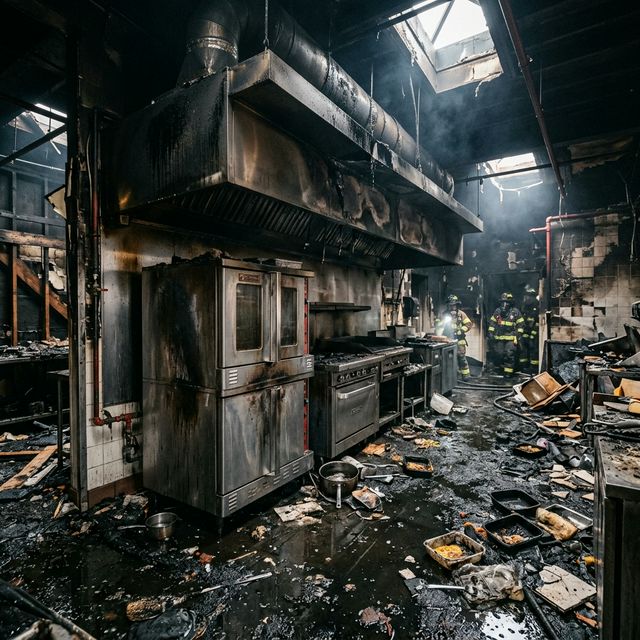
Kitchen fires are the #1 cause of restaurant insurance claims and among the most complex to document properly. A grease fire that appears to affect only the cooking line can compromise the entire building.
The Hood System and Fire Suppression Commercial kitchen hood systems are the most expensive single line item in most restaurant fire claims. A Type I hood with integrated fire suppression, makeup air, and exhaust can cost $50,000-$150,000 to replace. After any fire, the hood system must be fully inspected and often completely replaced — along with all associated ductwork that may have been compromised by heat or grease-laden smoke.
Grease Migration During a kitchen fire, vaporized grease becomes airborne and deposits on every surface the smoke touches. This greasy film cannot simply be wiped down; it penetrates porous materials like drywall, ceiling tiles, and insulation. The entire affected area typically requires demolition and replacement, not just cleaning. Insurers routinely try to approve "cleaning and sealing" to avoid the cost of full replacement.
Electrical and Gas System Contamination Heat from kitchen fires can melt electrical insulation, warp gas lines, and compromise the integrity of fire-rated assemblies. These hidden damages require inspection by licensed electricians and gas fitters, and the cost of bringing systems up to current code can significantly exceed the insurer's initial estimate.
Structural Heat Damage Commercial kitchens generate intense, concentrated heat during a fire. Steel structural members above the cooking line may have lost tensile strength. Concrete floors may have cracked from thermal shock. A forensic structural engineer is required to certify the integrity of all load-bearing elements — a step insurers actively avoid.
4. The Commercial Kitchen Equipment Valuation Battle
Commercial kitchen equipment is where restaurant claims become truly contentious. Insurers consistently undervalue, over-depreciate, and attempt to "repair" equipment that should be fully replaced.
| Equipment | Insurer's Approach | PA's Approach |
|---|---|---|
| Walk-in Cooler/Freezer | Repair compressor; ignore contamination | Full replacement + installation |
| Hood System | Clean and recertify existing system | Full code-compliant replacement |
| Commercial Oven/Range | Depreciate to 30% of replacement cost | Full replacement at current market price |
| POS / Technology | Offer refurbished replacements | New equivalent systems + data recovery |
| Smallwares & Utensils | Lump sum estimate; skip inventory | Item-by-item replacement inventory |
A commercial combination oven costs $25,000-$45,000 new. A walk-in cooler/freezer installation runs $15,000-$50,000. A full commercial dishwashing system with booster heater costs $8,000-$20,000. When insurers depreciate these to 40% of replacement cost and propose "cleaning" soot-contaminated compressors, the gap between their offer and the true cost of restoring your kitchen can be $100,000 or more.
A public adjuster compiles a comprehensive equipment schedule with current market replacement costs, installation labor, and code-required modifications. They fight the depreciation battle line by line, ensuring you receive enough to actually rebuild your kitchen — not just enough to close the file.
5. Water Damage and Mold in Food Service Environments
Water damage claims in restaurants carry a unique urgency: any moisture intrusion in a food preparation environment creates an immediate health and safety crisis. Mold growth that might be tolerable (in the short term) in an office building is a shutdown-level violation in a restaurant.
The 48-Hour Mold Clock In warm, humid environments (exactly what a commercial kitchen provides), mold can begin colonizing in as little as 24-48 hours after water intrusion. If the property is not immediately and aggressively dried using commercial dehumidification, mold remediation costs can escalate from $5,000 to $50,000+ — and your health department will not allow you to reopen until professional clearance testing confirms the space is safe for food preparation.
Contamination of Food-Contact Surfaces Any water damage in a food service environment raises contamination concerns for all food-contact surfaces. Walk-in coolers, prep tables, cooking equipment, and storage areas that contact floodwater or sewage backup must be replaced, not cleaned. Health codes in most jurisdictions require documentation that all food-contact surfaces are either new or professionally sanitized and certified.
Subflooring and Drainage Restaurant floors are designed with specific drainage slopes, grease-resistant coatings, and commercial-grade subflooring. Water damage that compromises these systems requires a complete tear-out and rebuild to meet health code — a cost that insurers routinely underestimate or deny as "maintenance."
6. Insurer Tactics Specific to Restaurant Claims
Restaurant claims trigger industry-specific tactics that go beyond standard commercial claim games:
The "Maintenance Neglect" Defense For grease fires, insurers frequently argue that the fire resulted from inadequate hood cleaning or grease trap maintenance — implying that the loss was caused by the owner's negligence rather than a covered peril. A public adjuster documents your maintenance records (hood cleaning invoices, grease trap service logs, fire suppression system inspections) to neutralize this defense.
The "Equipment Was Already Old" Depreciation Commercial kitchen equipment has long usable life spans, but insurers will apply aggressive depreciation schedules that value a 5-year-old commercial range at 40% of replacement cost. The reality is that a properly maintained commercial range functions at 95%+ capacity for 15-20 years. A public adjuster fights the depreciation calculation line by line.
The "You Can Cook Somewhere Else" BI Minimization Insurers may argue that you could have operated from a food truck, ghost kitchen, or shared commissary to reduce your Business Interruption loss. While these options may be viable for some operators, the insurer cannot force you to operate from an inferior facility. The BI calculation should reflect the revenue you would have earned in your full-service location.
7. Health Department Compliance and Recertification
One of the most underappreciated cost drivers in restaurant claims is health department compliance. After any significant fire, water, or structural damage, your restaurant must pass a full health department reinspection before reopening. This creates costs and delays that insurers consistently underestimate.
Pre-Opening Inspection Requirements Health departments treat a post-damage restaurant essentially like a new build. You will need to demonstrate: compliant food-contact surfaces, properly functioning refrigeration at required temperatures, adequate handwashing stations, functioning grease traps and drainage, fire suppression system certification, structural integrity of all food preparation areas, and proper ventilation and makeup air systems.
The Timeline Impact Health department inspections are not expedited for insurance claims. In many jurisdictions, scheduling a pre-opening inspection takes 2-4 weeks after you submit the request, and the inspection itself may require multiple visits. Each failed item requires remediation and reinspection. This timeline directly extends your Business Interruption claim period.
Code Upgrades If your restaurant was built before current health codes were adopted, the reinspection may trigger mandatory upgrades. New ADA requirements, updated grease trap sizing, additional handwashing stations, and current ventilation standards can add $20,000-$75,000 to your rebuild cost — all of which should be claimed under your Ordinance and Law coverage.
8. Perishable Inventory and Food Spoilage Claims
Perishable inventory is a significant and time-sensitive component of restaurant claims. Whether caused by power outage, refrigeration failure, smoke contamination, or water damage, food spoilage requires immediate documentation.
Documentation Protocol Before discarding any food: photograph every shelf, drawer, and storage area; create a detailed inventory list with quantities, product names, and approximate purchase costs; save purchase receipts and vendor invoices for the prior 30 days; and record refrigerator/freezer temperatures to document the break in the cold chain.
Beyond the Walk-In Spoilage claims extend beyond refrigerated food. Dry goods contaminated by smoke, soot, or water are equally claimable. Spices, flour, sugar, oils, canned goods — any food product that could have been contaminated by a covered peril should be included in your inventory.
Beverages and Alcohol Bar inventory — wine, spirits, craft beer — can represent $10,000-$50,000+ in value at a full-service restaurant. Heat exposure, smoke contamination, or refrigeration failure can destroy this entire inventory. Insurers often undervalue alcohol inventory by using wholesale pricing; a public adjuster documents replacement costs at your actual vendor pricing.
9. Retail Store Damage: Inventory, Fixtures, and Tenant Improvements
Retail stores present unique claim challenges centered on high-value, fluctuating inventory and custom tenant improvements.
Inventory Valuation Retail inventory values fluctuate dramatically by season. A clothing store's inventory may be worth $50,000 in January but $200,000 in November heading into the holiday season. A public adjuster ensures the inventory is valued at the date of loss, not a low-season estimate. For fashion and seasonal goods, current market value (not cost) is often the appropriate metric.
Custom Fixtures and Tenant Improvements Retail stores invest heavily in custom fixtures, display cases, signage, lighting, and interior buildouts designed to create a specific brand experience. These Tenant Improvements and Betterments (TI&B) are covered under your policy but are frequently undervalued by insurers who estimate basic construction costs without accounting for the custom design, specialized materials, and brand-specific finishes.
Loss of Foot Traffic Retail businesses depend on physical location and visibility. A closure of several months does not just cost you the revenue during that period — it trains your customers to shop elsewhere. Extended Business Income coverage addresses this ramp-up period, but only if properly invoked and documented.
10. Business Interruption for Restaurants and Retail
Business Interruption coverage is often the single largest component of a restaurant or retail claim — frequently exceeding the cost of physical repairs. Restaurants that gross $1-3 million annually and close for 6 months face BI losses of $500,000-$1.5 million.
Seasonal Revenue Modeling Restaurant and retail revenue is highly seasonal. An Italian restaurant may do 40% of its annual revenue during the holiday season (November-February). If the fire occurs in October and the restaurant does not reopen until May, the BI model must capture this peak season loss — not use the summer slow-season as its baseline. Insurers will always attempt to use the lowest-performing period.
Catering and Event Revenue Many restaurants generate significant revenue from catering, private events, and holiday bookings. A BI model must include projected catering revenue based on historical bookings, signed contracts, and seasonal demand. This revenue stream is frequently excluded from insurer calculations.
Staff Rebuilding Costs After months of closure, restaurants face the challenge of recruiting and training an entirely new staff. The costs of rehiring — job postings, training meals, reduced efficiency during the learning curve — are legitimate claims under Extra Expense coverage.
11. Real-World Scenario: The BBQ Restaurant Kitchen Fire
A popular BBQ restaurant in Nashville experienced a grease fire in the smoker room that quickly spread to the main kitchen. The fire was extinguished within 20 minutes, but the damage was extensive.
The Insurer's Assessment: The insurance adjuster estimated $118,000 — covering kitchen drywall replacement, cleaning of the existing hood system, repair of the walk-in cooler compressor, and a 6-week Business Interruption payment based on the restaurant's slowest month (January).
The Public Adjuster's Investigation: The PA brought in a commercial kitchen consultant who determined the hood system was irreparably contaminated with carbonized grease throughout the ductwork and required complete replacement ($85,000). The walk-in cooler's evaporator coils were corroded by acidic smoke — not repairable, requiring full replacement ($32,000). A structural engineer found that steel framing above the smoker room had warped from sustained heat exposure. The health department informed the owner that the restaurant would be treated as a new build, requiring ADA upgrades to the restrooms and a larger grease trap ($28,000 in code upgrades). The PA's forensic accountant documented a realistic 7-month restoration timeline (including 8 weeks for hood system fabrication, 6 weeks for permitting, and 3 weeks for health department scheduling) and modeled BI revenue using a 12-month average that captured the lucrative summer BBQ season and fall football game days.
The Final Settlement: $467,000 — nearly 4x the original offer. The settlement covered full kitchen rebuild, equipment replacement, code upgrades, and 7.5 months of Business Interruption including Extended BI. The restaurant reopened stronger than before.
12. Frequently Asked Questions
Does insurance cover restaurant grease fire damage? Yes. Commercial property policies cover grease fires, kitchen fires, and electrical fires in restaurants. However, insurers often try to attribute grease fires to "negligent maintenance" to reduce payouts. A public adjuster documents proper maintenance records and fights this tactic.
How long does a restaurant insurance claim typically take? Restaurant claims typically take 4-12 months due to equipment lead times (hood systems can take 8-12 weeks to fabricate), permitting requirements, and health department reinspection scheduling. A public adjuster accelerates the process by submitting comprehensive documentation and securing interim payments to cover your lease, payroll, and living expenses during the closure.
Can I claim lost catering revenue during a restaurant closure? Absolutely. Projected catering and event revenue is part of your Business Interruption claim. The forensic accountant documents historical catering bookings, signed contracts for upcoming events, and seasonal demand patterns to calculate the lost revenue.
What if my retail store's inventory fluctuates seasonally? Inventory is valued at the date of loss, not an annual average. If your store was fully stocked for the holiday season when a pipe burst destroyed your inventory, you are entitled to the full replacement cost of that seasonal stock — not a yearly average.
Does my restaurant lease require me to carry renter's insurance separately? Most commercial leases require tenants to carry their own Business Personal Property and Business Interruption coverage while the landlord's policy covers the building structure. Your PA coordinates with both policies to ensure comprehensive recovery.
13. Next Steps: Your Free Restaurant Claim Review
A damaged restaurant is not just a damaged building — it is a family's livelihood, an employee team's income, and a community's gathering place. The financial decisions you make in the days after a loss determine whether your restaurant survives or becomes another statistic.
If your restaurant or retail business has suffered fire, water, storm, or any form of property damage, you deserve expert representation that understands the unique complexities of food service and retail claims.
At PublicAdjusterSelect.com, we connect restaurant and retail business owners with deeply experienced, fully vetted commercial public adjusters who specialize in food service losses. The initial review is entirely free, and you pay nothing upfront. Submit your information below, and a dedicated specialist will contact you within 24 hours.