
Comprehensive Warehouse & Industrial Damage Guide
- Free Claim Review
- 1. Warehouse & Industrial Claims: When Millions Are at Stake
- 2. The Blunt Truth (BLUF)
- 3. Types of Industrial Properties We Handle
- 4. Roof Collapse and Structural Damage Claims
- 5. Industrial Fire and Explosion Claims
- 6. Equipment Breakdown and Machinery Claims
- 7. Inventory and Stock Loss Valuation
- 8. Insurer Tactics on Industrial Claims
- 9. Industrial Business Interruption and Supply Chain Loss
- 10. Environmental and Hazmat Considerations
- 11. Real-World Scenario: The Distribution Center Roof Collapse
- 12. Frequently Asked Questions
- 13. Next Steps: Your Free Industrial Claim Review
1. Warehouse & Industrial Claims: When Millions Are at Stake
Industrial and warehouse facilities represent some of the highest-value properties in the insurance landscape. A single distribution center can house $5-50 million in inventory. A manufacturing plant may contain $10-100 million in specialized equipment. When these facilities suffer damage — from storms, fire, flooding, or equipment failure — the claims are massive, complex, and fiercely contested.
Industrial Damage by the Numbers
Insurance companies deploy their most senior adjusters, engineering firms, and legal teams on industrial claims. They know that a warehouse owner facing months of disrupted operations and millions in damages will feel immense pressure to accept the first offer and get operations running again. A public adjuster neutralizes that pressure by securing interim payments while fighting for the full settlement you are owed.
2. The Blunt Truth (BLUF)
Industrial insurance claims are not residential claims with bigger numbers. They involve fundamentally different policy structures, valuation methods, and negotiation dynamics. Your commercial policy likely has coinsurance provisions, equipment breakdown endorsements, spoilage coverage, contingent business interruption riders, and environmental liability sub-limits — each with its own deductible, cap, and activation requirements.
An insurer's adjuster will exploit every gap in your understanding of these coverage layers. A public adjuster who specializes in industrial losses navigates these complexities daily. They know which coverage applies to which loss component, how to sequence multiple coverage invocations, and how to present a unified Proof of Loss that maximizes recovery across every applicable policy provision.
3. Types of Industrial Properties We Handle
Our network of industrial public adjusters handles the full spectrum of warehouse and industrial facility claims:
- Distribution and Fulfillment Centers: Roof collapse, sprinkler system failure, inventory damage from water or fire
- Manufacturing Plants: Equipment breakdown, production line damage, chemical spills, explosion damage
- Cold Storage and Refrigerated Warehouses: Refrigeration failure, power outage, ammonia system leaks, product spoilage
- Food Processing Facilities: Contamination events, USDA/FDA compliance shutdowns, product recall costs
- Automotive and Heavy Equipment Shops: Fire damage from welding/cutting operations, paint booth fires, vehicle inventory damage
- Logistics and 3PL Facilities: Third-party goods damage (bailee coverage), dock damage, conveyor system breakdown
- Chemical and Pharmaceutical Plants: Hazmat events, containment breaches, regulatory shutdown costs
- Agriculture and Grain Storage: Silo damage, crop spoilage, equipment breakdown, wind/hail damage
- Data Centers and Server Farms: Cooling system failure, power interruption, equipment overheating
4. Roof Collapse and Structural Damage Claims
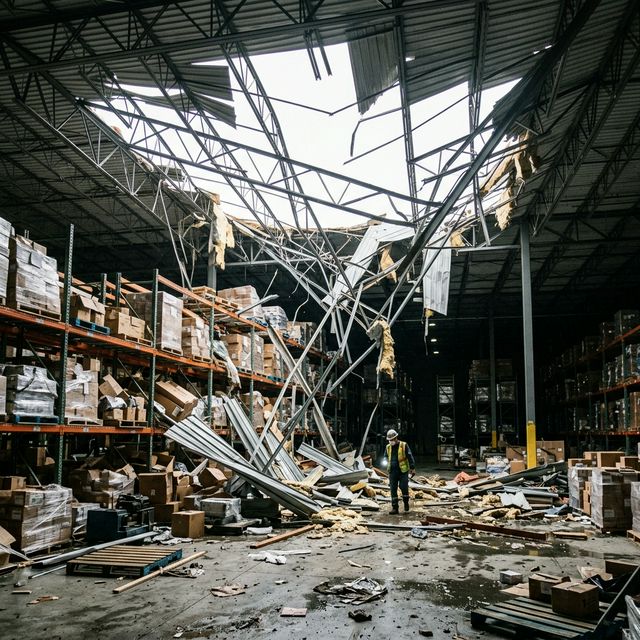
Warehouse roofs are the most frequent and highest-value structural claim component in industrial insurance. These massive, flat or low-slope roofing systems spanning 50,000-500,000+ square feet are particularly vulnerable to wind uplift, hail impact, ponding water, and snow load.
Wind and Hurricane Damage High winds can peel back roofing membranes, displace edge metal, and create points of water intrusion across thousands of square feet. Insurers routinely argue that wind damage is "cosmetic" or "pre-existing wear." A public adjuster engages independent roofing consultants to core-sample the membrane, prove the damage was storm-caused, and document the full scope of affected area.
Hail Damage to Industrial Roofing Large hail can compromise the waterproof integrity of TPO, EPDM, and built-up roofing systems without visible surface damage. Functional damage — where the membrane's waterproofing ability is compromised even though the surface looks intact — is a major point of dispute. Independent testing proves what the insurer's visual inspection is designed to miss.
Partial vs. Full Roof Replacement Insurers will always attempt to approve a partial roof repair — patching only the visibly damaged area while leaving the surrounding membrane (which may be functionally compromised) in place. If the roofing manufacturer will not warranty a patch job, or if the damaged area exceeds a threshold percentage of the total roof, a full replacement is the only proper remedy.
Interior Damage from Roof Failure When a warehouse roof leaks or collapses, the water damage to everything below — inventory, equipment, flooring, electrical systems — often exceeds the cost of the roof repair itself. Insurers may try to separate the roof claim from the interior damage claim to apply separate deductibles or sub-limits.
5. Industrial Fire and Explosion Claims
Industrial fires are among the most catastrophic commercial losses. The combination of combustible materials, chemical accelerants, high-BTU heat sources, and large open floor plans creates conditions for rapid fire spread that can destroy an entire facility in hours.
Fire Suppression System Activation When a warehouse sprinkler system activates, the water damage from the suppression often rivals the fire damage. Industrial sprinkler heads discharge 15-50 gallons per minute, and in a large facility, dozens of heads may activate simultaneously. The resulting deluge can destroy palletized inventory, short-circuit electrical panels, and saturate concrete slabs — all of which creates secondary claims for water damage, mold, and equipment corrosion.
Smoke and Soot in Large Facilities In warehouse environments, smoke and soot travel enormous distances through the open floor plan and HVAC systems. Inventory stored 200 feet from the fire origin can be contaminated beyond salvage. Insurers often try to "clean" soot-contacted inventory rather than replace it — a particular problem for sensitive products like electronics, pharmaceuticals, or food-grade materials.
Structural Steel Inspection Steel-framed warehouses are designed to maintain structural integrity under normal conditions, but intense fire can cause permanent deformation. A forensic structural engineer must inspect all steel members for warping, buckling, and loss of tensile strength. If compromised, the steel must be replaced — not painted over or ignored.
6. Equipment Breakdown and Machinery Claims
Industrial equipment is often the most valuable asset in a facility — and the most contentious line item in a claim. Specialized manufacturing equipment can cost $500,000-$10 million per machine, with lead times of 6-18 months for replacement.
| Equipment Issue | Insurer's Approach | PA's Approach |
|---|---|---|
| CNC Machine Damage | Repair the visible components; ignore calibration | Full replacement + recalibration certification |
| Conveyor Systems | Replace damaged sections only | Full system assessment + replacement if compromised |
| HVAC / Industrial Cooling | Repair compressors; clean ductwork | Full replacement for contaminated systems |
| Electrical Switchgear | Visual inspection; claim acceptable | Thermal imaging + dielectric testing |
| Specialized Tooling | Depreciate to scrap value | Functional replacement cost appraisal |
Functional Replacement Cost vs. Book Value The most common equipment valuation dispute centers on how to value damaged machinery. Insurers will use depreciated book value (what the asset is worth on your balance sheet after years of accounting depreciation) while your policy likely provides Functional Replacement Cost (the cost to replace the machine with one of similar capability). The difference can be enormous: a $2 million CNC milling center with a book value of $400,000 costs $2.2 million to replace today.
Consequential Damage When one piece of equipment fails or is damaged, it often triggers cascading damage to connected systems. A compressor failure can cause refrigerant leaks, spoil temperature-sensitive inventory, and damage other components in the cooling loop. A public adjuster traces the full chain of consequential damage.
7. Inventory and Stock Loss Valuation
Warehouse inventory claims are notoriously complex because they involve thousands of SKUs, fluctuating valuations, and multiple ownership structures.
Your Inventory vs. Customer Inventory If you operate as a 3PL (third-party logistics) provider, your warehouse may contain goods owned by multiple customers. Your own property coverage applies to your inventory; damage to customer goods triggers Bailee's Customer coverage or your Legal Liability endorsement. Each coverage has different limits and deductibles.
Valuation Methods Inventory can be valued at: cost (what you paid), selling price (what you would have received), or replacement cost (what it costs to restock today). The correct method depends on your policy language and the type of goods. Raw materials are typically valued at replacement cost; finished goods at selling price minus saved expenses. Insurers will always select the method that produces the lowest number.
Salvage Operations After a loss, insurers will push aggressively for salvage operations — sorting through damaged inventory to identify items that can be cleaned, repacked, and sold. While salvage is appropriate for some goods, it is not appropriate for food-grade products, pharmaceuticals, electronics, or any product where contamination compromises safety or regulatory compliance. A public adjuster ensures salvage decisions are made based on product safety, not insurer cost savings.
8. Insurer Tactics on Industrial Claims
Industrial claims draw the most aggressive insurer tactics because the stakes are highest. Understanding the playbook is essential.
The "Pre-Existing Condition" Defense On large structural claims, insurers deploy engineering firms to argue that damage was caused by deferred maintenance, pre-existing structural deficiencies, or design flaws — not the covered peril. This is particularly common on roof claims, foundation damage, and equipment failures. A public adjuster counters with independent engineering reports that establish the causal connection to the covered event.
The Independent Adjuster Swarm For large industrial losses, insurers may assign multiple adjusters — one for the building, one for contents, one for business interruption, one for equipment. This divide-and-conquer strategy creates silos where each adjuster minimizes their component without considering the total loss. Your public adjuster manages the claim holistically, ensuring nothing falls between the cracks.
The Expert Battle Insurers retain their own engineers, forensic accountants, and equipment appraisers. These experts are selected and paid by the insurance company. Without your own experts, the insurer's version of your loss becomes the only version on record. A public adjuster assembles an independent expert team whose findings represent your interests.
The "Quick Advance" Trap Insurers may offer a quick advance payment of $100,000-$500,000 to demonstrate good faith. While the cash is welcome, accepting it can create a psychological anchor point. The advance represents what the insurer wants you to think the claim is worth. A public adjuster welcomes advance payments while making clear they do not represent the final settlement value.
9. Industrial Business Interruption and Supply Chain Loss
For manufacturing and distribution facilities, Business Interruption losses often exceed the physical damage by a factor of 2-5x. A manufacturing plant that cannot produce product loses revenue, breaches supply contracts, and may permanently lose customers to competitors.
Manufacturing Downtime If your production line is down for 6 months, your BI claim covers: lost revenue from product you could not manufacture and sell, continuing fixed costs (lease, insurance, key personnel), extra expenses to maintain partial operations (outsourcing production, expedited component procurement), penalties or costs from breached supply contracts.
Supply Chain Interruption Modern manufacturing relies on just-in-time supply chains. If your facility is the supplier, your customers' operations are disrupted. If your supplier's facility is damaged, your operations halt. Contingent Business Interruption coverage addresses both scenarios, but invoking it requires detailed documentation of the causal chain and financial impact.
Seasonal and Cyclical Revenue Many industrial businesses have seasonal demand patterns. A HVAC equipment manufacturer does most of its business in spring; a heating equipment distributor peaks in fall. The BI calculation must capture the revenue pattern of the specific interruption period, not an annual average.
10. Environmental and Hazmat Considerations
Industrial facilities often involve hazardous materials that create additional claim complexity:
Environmental Cleanup Costs If a fire, explosion, or spill releases hazardous materials — petroleum products, industrial chemicals, refrigerants, or asbestos — the cleanup costs can be staggering. Standard property policies may include limited pollution coverage, but environmental endorsements or separate environmental liability policies may be required for full recovery.
Regulatory Shutdown An EPA, OSHA, or state environmental agency investigation can extend your facility closure by weeks or months beyond the physical repair timeline. This regulatory period should be included in your Business Interruption claim as part of the legitimate "period of restoration."
Asbestos Abatement Older industrial buildings may contain asbestos in insulation, roofing materials, floor tiles, or pipe wrapping. Any demolition or renovation work that disturbs asbestos triggers mandatory abatement procedures that add significant cost and time. Your Ordinance and Law coverage should cover abatement costs, but only if properly invoked.
11. Real-World Scenario: The Distribution Center Roof Collapse
A 120,000 sq ft distribution center in Tampa suffered a partial roof collapse during a severe thunderstorm with 80+ mph straight-line winds. Approximately 30,000 sq ft of the roof system failed, exposing the facility to torrential rain.
The Insurer's Assessment: The insurance company's adjuster and engineering firm attributed the collapse to "deferred maintenance and pre-existing ponding conditions." They offered $340,000 for partial roof repair, limited interior water damage cleanup, and denied the Business Interruption claim entirely, arguing the owner could have been operational within 3 weeks.
The Public Adjuster's Investigation: The PA retained an independent structural engineer and a licensed roofing consultant. The engineer's report conclusively demonstrated that the wind speed exceeded the roof system's design capacity, and that the "ponding" cited by the insurer's engineer was actually caused by wind-displaced drainage components — a direct result of the storm. The PA documented: $890,000 in full roof replacement (the remaining undamaged sections could not be patched to the manufacturer's warranty specifications), $420,000 in inventory damage (palletized electronics destroyed by rainwater intrusion), $95,000 in conveyor system damage from water exposure, $65,000 in electrical panel replacement, and 5.5 months of Business Interruption covering lost distribution revenue, contract penalties, and temporary storage for customer goods at off-site facilities.
The Final Settlement: $2.1 million — more than 6x the original offer. The insurer's "maintenance" defense collapsed once the independent engineering report established the storm as the proximate cause. The owner was able to fully rebuild the facility, replace all damaged equipment and inventory, and compensate affected customers.
12. Frequently Asked Questions
Does insurance cover warehouse roof collapse from storms? Yes. Commercial property policies cover roof collapse from wind, hail, snow load, and storm damage. Insurers frequently attribute collapse to pre-existing maintenance issues. A public adjuster brings in independent structural engineers to document the storm-caused damage and fight the maintenance exclusion defense.
How are industrial equipment losses valued? Industrial equipment should be valued at functional replacement cost — the cost to replace the damaged machine with one of similar capacity and capability at today's prices. Insurers often use depreciated book value or propose used/refurbished equipment. A public adjuster obtains independent appraisals to establish proper valuation and fights the depreciation battle line by line.
What if my warehouse stores third-party goods? If you store goods owned by others (as a 3PL provider), your Bailee's Customer coverage or Legal Liability coverage applies. The claim is more complex because you must document both your own losses and the value of customer goods. A public adjuster coordinates all coverage layers and ensures your customers' losses are properly claimed.
Can I claim supply chain disruption losses? If your policy includes Contingent Business Interruption coverage, you can claim losses caused by damage to a key supplier or customer's property. Standard BI coverage applies only to your own property damage. A public adjuster reviews your policy for all applicable coverage extensions.
How long do large industrial claims take to settle? Complex industrial claims typically take 6-18 months to reach full settlement. The PA accelerates the process by submitting comprehensive documentation, engaging independent experts, and securing interim payments to fund emergency repairs and maintain operations.
13. Next Steps: Your Free Industrial Claim Review
When an industrial facility suffers damage, the financial consequences cascade through every aspect of the business: production halts, supply chains break, contracts are breached, and employees are displaced. The speed and completeness of your insurance recovery determines whether your operation survives or sustains permanent damage.
If your warehouse, manufacturing plant, distribution center, or industrial facility has suffered property damage — or if your existing claim has been undervalued, delayed, or denied — you need representation that matches the scale and complexity of your loss.
At PublicAdjusterSelect.com, we connect industrial facility owners with deeply experienced, fully vetted commercial public adjusters who specialize in large-scale warehouse and manufacturing losses. The initial review is entirely free, and you pay nothing upfront. Submit your information below, and a dedicated industrial claim specialist will contact you within 24 hours.