Public Adjuster for
Water Damage
Water damage is the #1 reason for property claims, and the #1 target for insurance denials. Don't fight a multi-billion dollar insurer alone. Get the settlement you're entitled to.
-
7x Higher Payouts: Maximize your settlement.
-
$0 Upfront: Your expert only gets paid when you do.
Free Claim Review
Calculate your potential recovery with an expert.
Claim Under Review
We've received your details. A local expert is reviewing your claim and will call you shortly.
Why Our Estimates Are Different
Insurers often use outdated regional databases or omit "difficult" line items like ordinance & law or specialized drying protocols. We use real-time market data to ensure your "pre-loss condition" standard is actually met.
Forensic Verification
Thermal imaging and moisture mapping data points are included with every claim submission. This makes it significantly harder for an insurance carrier to dispute the scope of professional restoration required.
7. Navigating the Insurance Policy: Coverage, Exclusions, and the Fine Print
Your homeowners insurance policy is a contract. And like most contracts, its value to you depends almost entirely on how well you understand what it says. The challenge is that insurance policies are written in a language designed for professionals - dense with defined terms, layered conditions, and cross-referenced exclusions.
The Declarations Page tells you how much coverage you have. The actual policy tells you when and how you can access it. In a water damage claim, that distinction is everything.
ACV vs. RCV: The Financial Baseline
Actual Cash Value (ACV) deducts depreciation. Replacement Cost Value (RCV) pays to restore "kind and quality" without deductions.
Policy Sublimits: The Hidden Caps
Insurers often cap specific losses regardless of your total limit. Common water damage caps include:
- Mold Remediation: Often capped at $5k - $15k.
- Sewer Backup: Often requires a separate endorsement.
- Personal Property: High-value items have individual caps.
Concurrent Causation
When both a covered (storm) and excluded (gradual leak) cause contribute to damage, complex "anti-concurrent" clauses can sink your claim. We document the covered trigger as the primary cause.
Duties After Loss: Don't Violate Your Contract
Failing to meet policy conditions gives the insurer grounds to deny even valid claims. Your requirements include prompt notification, reasonable mitigation (stopping the source), and cooperation with investigations.
8. The Water Damage Claim Process: Step-by-Step from Loss to Settlement
Understanding the full arc of a claim gives you control. Most homeowners stumble through the process reactively, but professional management ensures you stay several steps ahead of the insurance company's next move.
Stage 1: Immediate Response (Hours 0–24)
Actions: Stop the source, document with photos *before* extraction, and notify the insurer.
The PA Value: Engaging us early allows us to document the scene before cleanup alters critical evidence for the claim.
Stage 2: The Insurer's Inspection (Days 3–14)
Actions: The carrier's adjuster visits to form their initial position.
The PA Value: We attend this inspection to ensure every ceiling pocket, subfloor saturated area, and hidden wall cavity is included in the adjuster's official records from day one.
Stage 3: Estimate & Supplementation (Weeks 2–6)
Actions: We receive the insurer's offer and compare it line-by-line with our independent Xactimate estimate.
The PA Value: We prepare a formal "supplement" package - a documented rebuttal that demands additions for missed scope and undervalued materials.
Stage 4: Negotiation & Mediation (Weeks 4–16)
Actions: Sustained advocacy to close the gap between the initial offer and the true cost of restoration.
The PA Value: We handle all back-and-forth communication, pushing back on technical denials and escalating to management or appraisal if the carrier stalls.
Stage 5: Settlement & Depreciation Recovery
Actions: Payment is issued and repairs begin.
The PA Value: We track your repair invoices to ensure all withheld depreciation (the RCV holdback) is successfully claimed and released upon completion.
9. When Should You Hire a Water Damage Public Adjuster?
This is the question most homeowners ask too late. By the time they're frustrated, exhausted, and sitting across from an insurance settlement that doesn't come close to covering what it will actually cost to restore their home, they're already weeks or months into a process that would have looked very different with a public adjuster at the helm from the beginning.
The short answer is: the best time to hire a water damage public adjuster is as early as possible after the loss. Early involvement maximizes your adjuster's ability to document the scene before cleanup alters the evidence, attend the insurance company's inspection as your representative, and establish a strong strategic foundation before the insurer forms its initial position.
But early engagement isn't always possible. Life gets in the way. Homeowners don't always know public adjusters exist, or they assume their insurer will treat them fairly, or they try to handle it themselves before realizing they're in over their head. The good news: a public adjuster can step in at virtually any stage of the claims process - including after an initial offer has been made, after repairs have begun, and even after a claim has been denied.
Critical Situations Requiring Representation
Here are the specific situations that most clearly call for professional public adjuster representation:
When the Loss Is Large or Structurally Significant
There is no universal dollar threshold, but as a practical matter, the larger and more complex the loss, the greater the potential gap between an insurer's offer and what your policy actually owes you. If your initial gut reaction is "this is going to be a major repair" - trust it. Call a public adjuster before calling anyone else.
When Hidden Damage Is Suspected
If water was present for any significant period before discovery - a slow leak behind a wall or a roof intrusion - the invisible damage may far exceed what's visible on the surface. A public adjuster with thermal imaging equipment is far better equipped to uncover and document this than a homeowner navigating alone.
When Your Claim Has Been Underpaid
If you've received a settlement offer that feels inadequate - especially if contractor estimates significantly exceed it - you are not obligated to accept. A public adjuster can review the estimate, prepare an independent valuation, and negotiate to close the gap.
When Your Claim Has Been Denied
A denial letter is not the end of the road. It is a position that can be challenged. Public adjusters identify whether the denial is based on a legitimate exclusion or a misapplication of policy language.
When the Claims Process Has Stalled
When timelines slip and you can't get a straight answer, you may be experiencing "claim fatigue." A public adjuster knows how to apply pressure within the regulatory framework and escalate to state insurance department complaints when warranted.
When Mold Is Part of the Loss
Mold claims are aggressively disputed. Establishing that mold resulted from a covered water event rather than pre-existing conditions requires professional documentation that most homeowners cannot produce on their own.
When You're a First-Time Claimant
Going in uninformed against professionals who handle claims every day is a structural disadvantage. For first-time claimants facing a significant loss, professional guidance is almost always worth far more than the contingency fee.
10. How Much Does a Water Damage Public Adjuster Cost? (Fee Structures Explained)
One of the first questions homeowners ask - and one that sometimes keeps them from making the call - is how much a public adjuster costs. It's a fair question. But understanding how public adjuster fees are actually structured, what governs them, and what the return on investment typically looks like tends to reframe the cost question significantly.
The short version: in most cases, hiring a public adjuster costs you nothing out of pocket, and the increase in your settlement more than covers their fee. Here's the full picture.
The Contingency Fee Model
The overwhelming majority of public adjusters work on a contingency fee basis - meaning they charge a percentage of the final insurance settlement they recover for you. There is no upfront cost, no hourly rate, no retainer. If the public adjuster doesn't recover anything additional for you, you owe nothing beyond whatever was already settled before they were engaged.
This structure ensures that the public adjuster's financial interest is perfectly aligned with yours. Their compensation scales directly with the size of your settlement. The harder they fight for every dollar, the more they earn - and the more you recover.
Typical Fee Ranges
Public adjuster contingency fees typically range from 5% to 20% of the total claim settlement, depending on the claim size, complexity, and how early the adjuster is engaged. Larger, more complex claims often carry lower percentage fees, while smaller or late-stage claims may be on the higher end.
The ROI Case: Why the Fee Pays for Itself
The central financial question isn't what does a public adjuster cost - it's what is the net difference in my settlement after accounting for the fee?
Industry data consistently shows that policyholders who hire public adjusters receive significantly higher settlements than those who don't - with differences frequently ranging from 20% to 700% more than insurer-only settlements. Most reputable public adjusters offer free initial consultations to provide a preliminary assessment of whether representation is likely to add value in your specific case.
11. Real-World Results: How Public Adjusters Change Water Damage Claim Outcomes
Skeptics of the public adjuster model sometimes argue that a motivated, organized homeowner can achieve similar results by advocating for themselves. It's a reasonable hypothesis - but the data doesn't support it. Across multiple independent studies, insurance industry analyses, and state insurance department reports, the pattern is consistent and compelling: policyholders represented by public adjusters recover more. Often significantly more.
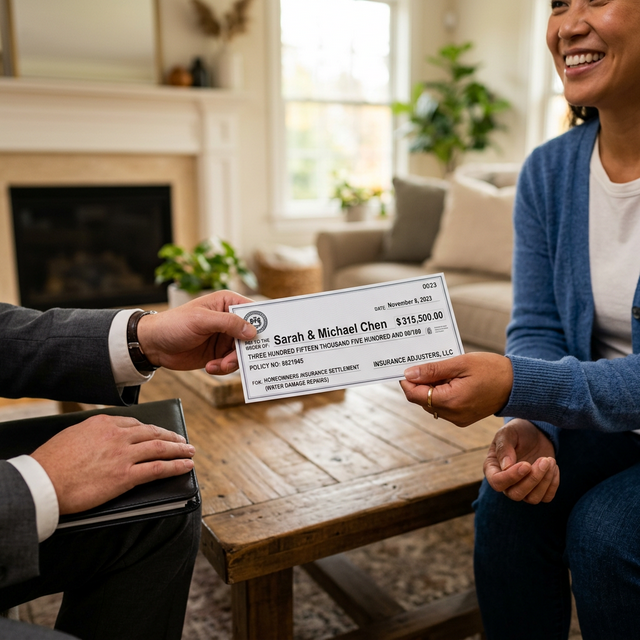
Represented policyholders consistently recover more, allowing for complete structural restoration rather than surface-level patches.
What the Research Shows
The most frequently cited independent research on public adjuster outcomes comes from a study commissioned by the Florida Office of Program Policy Analysis and Government Accountability (OPPAGA), which examined thousands of residential property insurance claims. The findings were striking:
| Claim Category | Average Payout Increase |
|---|---|
| Non-Catastrophe Claims | 7x Higher |
| Hurricane Related Claims | 574% Higher |
Why the Gap Is Especially Wide in Water Damage Claims
Water damage claims are particularly prone to under-settlement because of hidden damage, complex causation, and the insurer's ability to narrow scope through exclusions. In practice, the settlement gap traces back to several specific recoveries that homeowners typically miss:
- Hidden damage documentation: A public adjuster who opens up the structure and documents every affected system captures costs that an insurer's surface-level assessment misses.
- Mold remediation costs: Public adjusters document the causal chain to unlock coverage even when insurers initially deny it.
- Code upgrade costs: Ordinance and law coverage is one of the most commonly overlooked components, especially in older homes.
- Contents and personal property recovery: Thorough inventory documentation routinely recovers significantly more than general allowances.
- Recoverable depreciation: Public adjusters track and submit the required documentation to unlock the final "holdback" funds.
Case Study: The Cost of Hidden Damage
Location: Major Metropolitan Area | Loss: 2nd Floor Supply Line Failure
Addressed visible bathroom damage and a portion of the hallway floor.
Included full subfloor, wall cavity insulation, and mold remediation.
After the public adjuster's 10% fee ($8,740), the homeowner netted $78,660 - more than $47,000 above the original offer, enough to fully fund a proper restoration rather than a surface-level patch.
12. Mold and Water Damage: A High-Stakes Combination That Demands Expert Handling
Of all the complications that can arise from a water damage event, mold is the one that most reliably transforms a manageable insurance claim into a protracted, expensive battle. Mold is not a separate problem from water damage; it is its most predictable consequence, often colonizing surfaces within **24 to 72 hours** of exposure.
Why Insurers Fight Mold Claims So Aggressively
The insurance industry has tight policy language, mold exclusions, and establishing sublimits that dramatically cap mold coverage. Insurers look for any evidence that mold predated the event, resulted from humidity, or that the homeowner failed to mitigate promptly.
Mold Sublimits: Maximizing Recovery
Even with hard caps on mold coverage, a public adjuster looks for every opportunity to maximize recovery, such as structuring the claim to allocate costs between mold remediation and structural water damage repair, or identifying applicable endorsements that expand coverage.
The Health and Liability Dimension
Beyond the claim, mold carries real life-safety implications. Prolonged exposure to species like "black mold" is associated with serious respiratory issues. Homeowners who accept partial settlements may face recurring problems and potential liability during future property sales if remediation was inadequate.
Getting the mold component right the first time requires professional documentation and negotiation to ensure actually resolving the problem rather than just cosmetically addressing it.
Strategic Counter-Measures for Claim Denials
If your claim has already been denied, do not panic. Most "final" denials are technical arguments that can be countered with technical evidence.
| Common Denial Reason | The PA Challenge Strategy |
|---|---|
| "Gradual Seepage" | Expert review of leak origin and suddenness evidence. |
| "Pre-existing Mold" | Timeline documentation proving moisture preceded growth. |
| "Surface Water / Flood" | Meteorological data proving wind-driven rain vs. rising water. |
| "Negligent Maintenance" | Maintenance record review and appliance failure analysis. |
When a public adjuster takes on a denied claim, they conduct their own investigation to isolate the actual cause of loss. If the evidence supports a covered event, they submit a formal challenge to the denial, often supported by reports from independent engineers.
13. Commercial Water Damage Claims: Higher Stakes, Greater Complexity
In a commercial loss, property repair is only half the battle. The bigger financial exposure is frequently Business Interruption (BI) - the revenue lost while the doors are closed. Managing a commercial claim requires a level of forensic accounting and project coordination that goes far beyond a residential loss.

Commercial losses involve complex business interruption calculations and multi-tenant liability issues.
Business Interruption: More Than Just Lost Sales
Calculating BI is one of the most contentious areas of commercial insurance. Insurers often use overly simplistic formulas that fail to account for the nuances of your specific business. A public adjuster works with forensic accountants to document:
- Baselines and Trends: Proving what the business *would have* earned based on historical data, seasonal trends, and current market growth.
- Extra Expenses: Costs incurred to keep the business running at a temporary location or to expedite repairs.
- Extended Period of Indemnity: Coverage for the time it takes for business to return to "normal" levels after the physical repairs are complete.
Multi-Tenant Properties and Liability
In commercial buildings, water damage rarely stays confined to one unit. Navigating the complex web of responsibility between landlords, tenants, and multiple insurance policies requires a public adjuster who understands commercial lease structures and "additional insured" provisions.
Inventory and Specialized Equipment Losses
For many businesses, the water damage to inventory, specialized machinery, or sensitive electronics is the most significant loss. Establishing actual cash value vs. replacement cost for specialized assets requires the kind of independent valuation expertise that public adjusters bring to the table.
14. How to Choose the Right Water Damage Public Adjuster
Not all public adjusters are created equal. In a high-demand field, especially after major weather events, you will encounter adjusters ranging from highly experienced experts to "storm chasers" looking for a quick signature. Your choice of representative is the single most important variable in the outcome of your claim.
7 Questions to Ask Before You Hire
Use this checklist as your vetting tool during any initial consultation:
Verify their license number on the state insurance department website before signing anything.
Some firms use "salespeople" to sign you up and then hand the file to a junior adjuster. Ensure you know your primary point of contact.
Ask for results from claims with the same insurer you use.
The entire point is representation. They must be there when the insurer's adjuster is there.
Ensure the contingency percentage is clearly stated and whether they cover expert costs like engineers or hygienists upfront.
If they are overloaded, your claim will move slowly.
Specialized losses require specialized knowledge.
A reputable public adjuster will welcome these questions. If they seem defensive or rush you through the vetting process, consider it a significant red flag.
15. Mistakes Homeowners Make After Water Damage That Hurt Their Insurance Claims
In the chaos immediately following a water loss, it's easy to make technical errors that the insurance company will later use to reduce or deny your claim. Avoiding these common pitfalls is essential to protecting your recovery.
Top 7 Claim-Killer Mistakes
If the insurer's adjuster cannot physically inspect the item, they are unlikely to pay for it. Keep everything - even soaked carpet - in a pile outside if necessary until it's been documented.
Your policy requires you to take "reasonable steps" to prevent further damage. Failing to extract water or set up fans can give the insurer an opening to deny subsequent mold or rot claims.
Temporary repairs to prevent more damage are fine. Tearing out walls and rebuilding before the insurer sees the full extent of the loss is a major mistake.
How you describe the event matters. A simple misstatement about the timeline or cause of the leak can lead to a technical denial.
These contractors have a financial relationship with the insurance company. Their motivation is often to keep costs low, not to ensure the most thorough restoration.
Initial offers are almost always based on conservative estimates. You have the right to challenge the scope and the pricing.
Especially in coastal areas where hurricane or windstorm deductibles may apply, not knowing your out-of-pocket exposure can lead to poor financial decisions during cleanup.
Essential ACTIONS
- Take 100+ photos/videos before extraction begins.
- Keep a log of all interactions with the insurer.
- Demand a copy of the insurer's line-item estimate.
- Get an independent assessment of structural moisture.
DANGEROUS Moves
- Do not sign "work authorization" from random contractors.
- Do not assume silence from the insurer means agreement.
- Do not guess if you're unsure of an answer to an adjuster.
- Do not feel obligated to use the insurer's app for valuation.
16. State Licensing, Regulations, and Your Rights as a Policyholder
Hiring a public adjuster is not just a business transaction - it is your legal right as established by state insurance regulations across the United States. Understanding the framework that protects you ensures you aren't intimidated by the claims process.
Key Legal Protections
Most states have enacted specific "Policyholder Bill of Rights" that mandate transparency and fairness. Key protections typically include:
- Right to Representation: The insurer cannot discourage you from hiring a licensed public adjuster or refuse to work with one.
- Prompt Communication: Insurers are legally required to acknowledge your claim, begin investigations, and respond to communications within strict timelines (often 10-15 days).
- Written Justification: If any portion of your claim is denied, the insurer must provide a written explanation citing the specific policy language they are relying on.
- The Appraisal Clause: Most policies include a "mini-arbitration" provision that allows you to bypass the insurer's adjuster entirely if you cannot agree on the value of the loss.
17. Conclusion: Don't Navigate Water Damage Alone - Get the Settlement You're Entitled To
The days following a water damage event are among the most stressful a homeowner can face. The pressure to make quick decisions, the physical reality of a damaged home, and the complexity of the insurance process create a structural advantage for the insurance company. They handle thousands of claims a day; you handle perhaps one or two in a lifetime.
The Decision in Front of You
You have three primary paths forward:
- Accept the insurer's initial offer: The easiest path, but almost certainly the most expensive in the long run.
- Fight the insurer yourself: A path that requires hundreds of hours of work and deep technical knowledge you may not have.
- Hire professional advocacy: Let an expert handle the documentation, the valuation, and the negotiation, ensuring you get every dollar your policy promises.
At PublicAdjusterSelect.com, we believe every policyholder deserves a level playing field. We specialize in connecting homeowners with the most experienced, vetted water damage public adjusters in their market - professionals who work on contingency and only get paid when you do.